

Chemistry Past Questions And Answers
1081
An organic compound which reacts readily with bromine to form a compound with the formula CH3CHBrCH2Br is
- A. ethene
- B. propane
- C. butane
- D. propene
1082
A balanced chemical equation is based on the law of?
- A. Periodicity
- B. Constant composition
- C. Multiple proportion
- D. Conservation of mass
1083
Give the total mass of copper in 1gm of copper (II) sulphate [Cu = 40; S = 32; O = 16]
- A) 0.25g
- B) 0.50g
- C) 10g
- D) 2.5g
1084
If humid air is polluted by chlorine discharged, the air can be restored by sprinkling
- A. solid MnO2
- B. acidified KMnO4
- C. acidified FeSO4
- D. saturated NaCl(aq)
1085
The properties of electrovalent compounds include the following except
- A) High melting point and boiling point
- B) Conduction of electricity in the molten state
- C) High volatility at room temperature
- D) Ionization in aqueous solution
1086
Which of the following statements best explains the difference between a gas and a vapour?
- A. Unlike gases, vapours are liquids at room temperature
- B. Unlike gases, vapour can easily be condensed into liquids
- C. Unlike gases, vapour is readily converted into solids
- D. Vapours are generally denser than gases
1087
The boiling of fat and aqueous caustic soda is referred to as
- A. hydrolysis
- B. esterification
- C. acidification
- D. saponification
1088
The product of the electrolysis of dilute sodium hydroxide using platinum electrodes are
- A. Hydrogen and oxygen gases
- B. Water and hydrogen gas
- C. Water and sodium metal
- D. Sodium metal and oxygen gas
1089
The oxidation state of Cr in K2Cr2O7 is
- A) +7
- B) +6
- C) +5
- D) 4
1090
The functional groups present in the compound above are
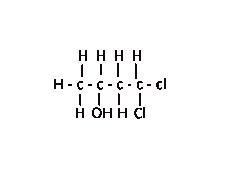
- A) alkene and halo-group
- B) hydroxyl and chloro-group
- C) alkene and chloro-group
- D) hydroxyl and halo-group