

Chemistry Past Questions And Answers
What is the number of oxygen atoms in 32g of the gas? (O = 16, L = 6.0 X 10²³ per mol)
- A. 3.2 X 10²³
- B. 6.0 X 10²³
- C. 1.2 X 1024
- D. 1.6 X 1024
Which of the following noble gases is commonly found in the atmosphere?
- A) Xenon
- B) Neon
- C) Helium
- D) Argon
What is the quantity of electricity produced when a current of 0.5A is passed for 5 hours 45 mins? (1F = 96500C)
- A) 0.11F
- B) 0.12F
- C) 0.22F
- D) 1.1F
(a) Give the name of the:
(i) process for obtaining ethanol from sugars;
(ii) compound produced when ethanol undergoes bacterial oxidation.
(iii) enzyme in yeast which catalyses the conversion of maltose to glucose.
(b)(i) Write the structural formula of ethanol
(ii) Name the organic product formed when propanoic acid reacts with ethanol.
View Discussion (0)WAEC 1996 THEORYThe atomic numbers of two elements X and Y are 12 and 9 respectively. The bond in the compound formed between the atoms of these two elements is
- A) ionic
- B) covalent
- C) neutral
- D) co-ordinate
Use the diagram to answer this question. The colour of the fountain water is
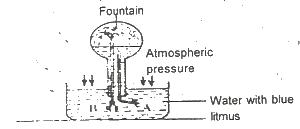
- A. blue
- B. orange
- C. red
- D. yellow
A visible change is observed when a strip of iron is placed in an aqueous solution of A
- A. FeSO4
- B. ZnSO4
- C. CuSO4
- D. MgSO4
Which of the following pairs of properties of alkali metals decreases down the group?
- A. First ionization energy and reactivity
- B. melting point and atomic radius
- C. Reactivity and electronegativity
- D. First ionization energy and melting point
CH3COOH(aq) + OH-(aq) ↔ CH3COO-(aq) + H2O(l) In the reaction above ,CH3COO-(aq) is
- A) conjugate base
- B) acid
- C) base
- D) conjugate acid
Tin is unaffected by air at ordinary temperature due to its
- A) Low melting point
- B) Weak electropositive character
- C) High boiling point
- D) White lustrous appearance