

Past Questions And Answers
Which of the following are structural isomers?
- A. propanoic acid and propan-1, 2-diol
- B. Propanal and propanone
- C. Ethanoic acid and propanoic acid
- D. Ethan-1, 2-diol and ethanoic acid
Choose the option that best completes the gap(s).
He isn't coming home, is he? ....... he isn't
- A. yes
- B. no
- C. why
- D. now
The right of citizens to participate in the affairs of government of their country is called
- A. economic right
- B. civil right
- C. political right
- D. social right
The commercial centre in the mapped area is
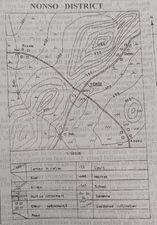
- A. NONSO
- B. Adaku
- C. Bukola
- D. Balu
Calculate the mean deviation of the set of numbers 7, 3, 14, 9, 7, and 8
- A. 13/6
- B. 5/2
- C. 7/6
- D. 7/3
| x | 6.20 | 6.85 | 7.50 |
| y | 3.90 | 5.20 | 6.50 |
The points on a linear graph are as shown in the table. Find the gradient (slope) of the line.
- A. 2\(\frac{1}{2}\)
- B. 2
- C. 1
- D. \(\frac{1}{2}\)
Calculate, correct to 2 significant figures, the length of the arc of a circle of radius 3.5cm which subtends an angle of 75° at the centre of the circle. [Take π = 22/7].
- A. 2.3cm
- B. 4.6cm
- C. 8cm
- D. 16cm
What were the major changes introduced in Nigeria by the Clifford Constitution of 1992 ?
View Discussion (0)WAEC 1995 THEORYDispersion occurs when white light passes through a glass prism because of the
- A) different hidden colours in the glass
- B) different speeds of the colour in the glass
- C) defects in the glass
- D) high density of the glass
(a).jpg)
In the diagram, < PTQ = < PSR = 90°, /PQ/ = 10 cm, /PS/ = 14.4 cm and /TQ/ = 6 cm. Calculate the area of the quadrilateral QRST.
(b) Two opposite sides of a square are each decreased by 10% while the other two are each increased by 15% to form a rectangle. Find the ratio of the area of the rectangle to that of the square.
View Discussion (0)WAEC 2010 THEORY