

Past Questions And Answers
Use the diagram below that shows the effect of nitrates on water bodies Study it carefully and answer questions.
The source of the nitrates in the diagram is termed
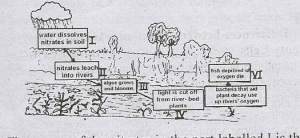
- A. root nodules of legumes
- B. cloud
- C. fertilizers
- D. organic matter
...Let the greying day grow,
...let the evening horns blow,
...let the melting mountains go...'
The repetition of these lines from Atukwei Okai's
- A. is for emphasis for the main ideas
- B. imbues the poem with lyrical qualities
- C. summarizes the major themes of the poem
- D. shows that the poem is truly a dirge.
A corrupt judicial system erodes the observance of ______?
- A. national peace and stability
- B. the rule of law
- C. international laws and conventions
- D. democratic values of the executive
\(\begin{vmatrix} -2 & 1 & 1 \\ 2 & 1 & k \\1 & 3 & -1 \end{vmatrix}\) = 23
- A. 1
- B. 2
- C. 3
- D. 4
Diction is a writer's choice of___________-
- A. Style
- B. Syntax
- C. Rhythm
- D. Words
Which of the following compounds determines the octane rating of petrol?
- A. 1,2,3 - trimethyl pentane
- B. 2,3,5 - trimethyl octane
- C. 2,3,5 - trimethyl pentane
- D. 2,2,4 - trimethyl pentane
In the wave equation y = Eo, sin(299t - \(\pi\)), Eo represents the
- A. amplitude
- B. frequency
- C. period
- D. wavelength
The process of inducing root development on portions of stems still attached to the parent plant is known as
- A. budding
- B. grafting
- C. layering
- D. tillering
(a)(i) List two elements which react with steam at red heat to produce hydrogen.
(ii) Explain why an aqueous solution of potassium bromide turned reddish brown on bubbling chlorine through it.
(iii) Write an equation for the reaction in (a)(ii).
(b)(i) Name two types of chemical industry that use limestone as raw material.
(ii) Give one example of hygroscopic substances.
(iii) Copy and complete the table below.
Salt to be prepared | Starting material | Method of preparation |
| PbSO\(4\) | Pb(NO\(_3)_{2(ag)}\) | - |
| KNO\(_3\) | KOH | Neutralization |
| CaCl\(_2\) | CaCO\(_3\) | - |
| FeCl\(_3\) | Fe\(_(s)}\) | - |
| CuSO\(_4\) | CuO | - |
(c) In the contact process for the manufacture of tetraoxosulphate (VI) acid;
(i) State how sulphur (IV) oxide is obtained;
(ii) Write an equation for the reaction that takes place in the catalyst chamber;
(iii) Give the steps required to convert sulphur (VI) oxide to acid.
(d)(i) List two disadvantages of hard water.
(ii) Mention three methods which can be used to remove both permanent and temporary hardness in water at the same time.
(iii) State the role of alum and chlorine respectively in the purification of water for town supply.
View Discussion (0)WAEC 1999 THEORYThe heat accompanying the reaction represented by the equation H2O (l) → H2O(g) is described as the heat of
- A. solution
- B. neutralization
- C. vaporization
- D. sublimation