

Past Questions And Answers
Read the poem and answer questions 13 to 15.
Here she lies, a pretty bud,
Lately made of flesh and blood;
Who as soon fell fast asleep
As her little eyes did peep.
Give her strewings, but not stir
The earth that lightly covers her.
The poem is about a/an ___________
- A. flower
- B. old woman
- C. little child
- D. traveller
A major economic activity among the Nupe was
- A. horse breeding
- B. leather work
- C. canoe-building
- D. cattle rearing.
In humans, excretion of hypertonic urine is associated with the
- A. distal convoluted tubule
- B. loop of Henle
- C. bowman's capsule
- D. proximal convoluted tubule
Prophet Ezekiel was set upon his feet to hear the Lord speak when
- A. the Spirit entered into him
- B. He was made to touch the ephod
- C. an angel of the Lord lifted him
- D. a voice from heaven commanded him to do so
The concentration of industries in a particular geographical area is
- A. localization of industries
- B. roles of industrialization
- C. location of industry
- D. strategies of industrialization
The bar chart below shows the number of visitors received in a week. How many visitors were received on Friday, Tuesday and Sunday?
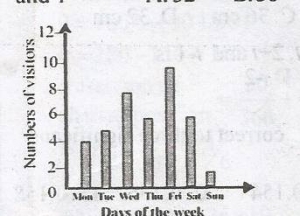
- A. 17
- B. 22
- C. 20
- D. 16
This question is based on General Literary Appreciation.
Weep not child, weep not my darling
With these kisses let me remove your tears
The ravening clouds shall no long be victorious
They shall no longer possess the sky....
The speaker of the lines is
- A. optimistic
- B. carefree
- C. helpless
- D. pessimistic
Which of the following statements is true of transhumance?
- A. It is the seasonal migration of animal rearers in mountainous areas
- B. It is practised by the Europeans
- C. It involves the growing of specialised crops
- D. It is another name for mixed farming
A tapeworm has no alimentary canal because
- A) it is antotropic
- B) it does not feed
- C) it has no enzymes
- D) its body absorbs digested food
Which of the following diseases of crops is not caused by a fungus?
- A. panama disease of banana
- B. smut of rice
- C. mould of stored grain
- D. streak of maize