

Past Questions And Answers
In which of the following groups of countries has heavy concentration of population been made possible by irrigation along fertile river valleys in an otherwise arid environment?
- A. Egypt, Ethiopia, India
- B. Egypt, Nambia , Somalia
- C. Egypt, Iran, Iraq
- D. Egypt, Chile,Australia
A weather element controlled mainly by latitude is?
- A. temperature
- B. humidity
- C. rainfall
- D. cloud cover
In the Igbo traditional political system, the Okpara was the
- A. administrative head of his kindred
- B. priest
- C. king
- D. commander-in chief of the army
The locus of a point which is 5 cm from the line LM is a
- A. line distance 10 cm from LM and parallel to LM
- B. pair of line on opposite sides of LM and parallel to it, each distance 5 cm from LM
- C. line parallel to LM and 5 cm from LM
- D. pair of parallel lines on one side of LM and parallel to LM
The diagram below illustrates a farm operation. Study it and answer the question
The illustrated farm operation is known as
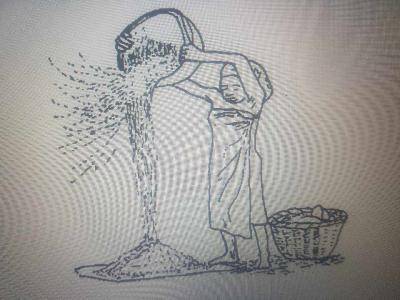
- A. winnowing
- B. milling
- C. shelling
- D. threshing
The application of the principle of separation of powers seems impracticable because powers is
- A. delegated
- B. centralized
- C. fused
- D. separated
He acts .................... he were a general manager
- A. as
- B. if
- C. as if
- D. so as
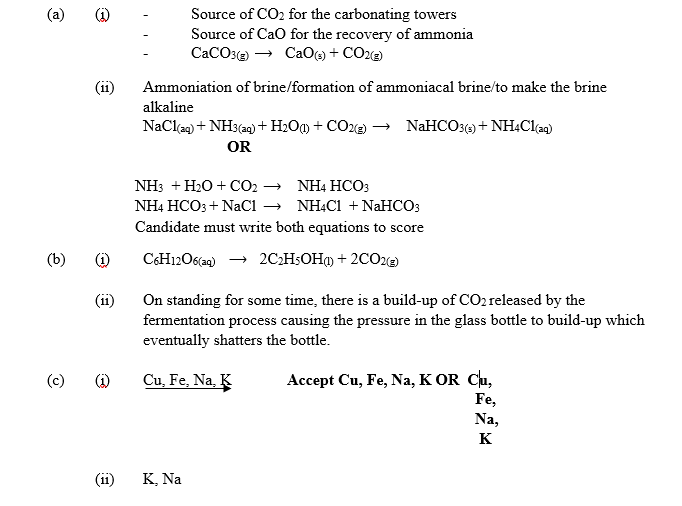
(a) In the Solvay process, explain briefly with equations the functions of the following substances:
- limestone;
- ammonia.
(b) (i) Write a chemical equation for the fermentation of glucose.
(ii) Explain briefly why a tightly-corked glass bottle filled to the brim with fresh palm-wine shatters on standing for some time.
(c) Consider the following metals: Na, Fe, K and Cu.
(i) Arrange the metals in order of increasing reactivity.
(ii) Which of the metals will react with cold water?
(ii) Which of the metals could form coloured salts?
(d)(i) What is aredox reaction?
(ii) Identify which of the following reaction equations are redox.
(I) 2Na + Cl\(_2\) → 2NaCl
(II) AgCl + 2NH\(_3\) → [Ag(NH\(_3\))\(_2\)]Cl
(III) C\(_2\)H\(_2\) + H\(_2\) → C\(_2\)H\(_4\)
(IV) HCl + KOH → KCl + H\(_2\)O
(V) 2FeCl\(_3\) + 2KI → 2FeCl\(_2\) + 2KCl + I\(_2\)
(iii) Give a reason for each of the answers in(d)(ii).
(iv) Write balanced equations of the half reactions for any two of the redox reactions in(d)(ii).
A piece of copper of mass 20g at a temperature of 110°C was dropped into a mixture of ice and water at 0°C. If the final steady temperature of the mixture is 0°C . Calculate the amount of ice that melted [Specific heat capacity of copper = 0.4 Jg\(^{-1}\)K\(^{-1}\), specific latent heat of fusion of ice = 330Jg\(^{-1}\)]
- A. 0.37g
- B. 0.60g
- C. 2.40g
- D. 2.70g
If \(8^{x+1}=\frac{1}{4}\), find x
- A. \(-\frac{5}{3}\)
- B. -1
- C. \(-\frac{1}{3}\)
- D. \(\frac{1}{3}\)