

Past Questions And Answers
The twenty-first term of an Arithmetic Progression is \(5\frac{1}{2}\) and the sum of the first twenty-one terms is \(94\frac{1}{2}\). Find the :
(a) first term ; (b) common difference ; (c) sum of the first thirty terms.
View Discussion (0)WAEC 2012 THEORYFreedom to act as one pleases but within the law is described as
- A. democracy
- B. separation of powers
- C. human right
- D. civic responsibility
Sierria Leone and Liberia were founded in what year _______ and _______ respectively
- A. 1787 and 1824
- B. 1824 and 1787
- C. 1856 and 1926
- D. 1926 and 1856
(a) What iscompetitive supply?
(b) With the aid of illustrations, differentiate between a supply schedule and a supply curve.
(c) Explain how the supply of a commodity is affected by the following:
(i) an improvement in technology;
(ii) a rise in input prices;
(iii) a rise in the prices of other commodities;
(iv) an increase in government subsidies on production.

Lobbying mainly involves the application of pressure on
- A. people in commerce through monetyary gifts
- B. legislators through material gifts
- C. people in government throught persasive arguments
- D. legislator by intimidation and blackmail
The innermost section of the Earth is the__________
- A. crust
- B. mantle
- C. core
- D. sial
(a) Outline the arguments used by Paul to defend the Resurrection.
(b) In what three ways is the Resurrection signi-ficant to believers?
View Discussion (0)WAEC 2011 THEORYln the diagram below, the galvanometer indicates a null-deflection. What is the potential difference between P and Q?
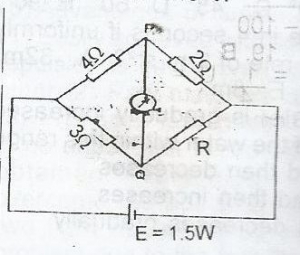
- A. 0.0 V
- B. 1.5 V
- C. 2.0 V
- D. 3.0V
The scope of economic activities can be enlarged by
- A. transportation and trading
- B. trading and aids to trade
- C. business and its promotion
- D. insurance and banking
A metal rod of length 40cm at 20°C is heated to a temperature of 45°C. If the new length of the rod is 40.05cm. Calculate its linear expansitivity
- A. 1.2 x \(10^{-5}K^{-1}\)
- B. 2.5x \(10^{-5}K^{-1}\)
- C. 3.5x \(10^{-5}K^{-1}\)
- D. 5x \(10^{-5}K^{-1}\)