

Past Questions And Answers
The following text is adapted from Gwendolyn Bennett’s 1926 poem “Street Lamps in Early Spring.” Night wears a garment All velvet soft, all violet blue... And over her face she draws a veil As shimmering fine as floating dew... And here and there In the black of her hair The subtle hands of Night Move slowly with their gem-starred light. Which choice best describes the overall structure of the text?
- A) It presents alternating descriptions of night in a rural area and in a city.
- B) It sketches an image of nightfall, then an image of sunrise.
- C) It makes an extended comparison of night to a human being.
- D) It portrays how night changes from one season of the year to the next
Mr. Akinwande prefers political science ____ law
- (A) than
- (B) to
- (C) more than
- (D) for
ALEX AGYEI-AGYIRI: Unexpected Joy at Dawn
Discuss Ni's encounter with -Put-t -to-me in the novel
An outright sale of a partnership amounts to the?
- A. compensation of vendors by the purchase
- B. admission of a new partner
- C. purchase of rights of a dead partner
- D. change of sharing ratio of vendors
A short poem lamenting the death of someone is
- A. an ode
- B. a threnody
- C. a sonnet
- D. an epic
What is the scale of the map in statement form?
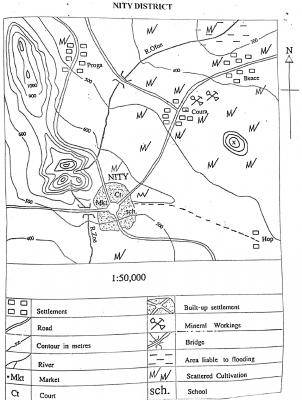
- A. one centimeter on the map represents half kilometer on the ground
- B. One centimeter on the map represents one kilometer on the ground.
- C. One centimeter on the map represents five kilometers on the ground
- D. One centimeter on the map represents fifteen kilometers on the ground.
which of the following agencies helps the most in shaping public opinion?
- A. pressure groups
- B. mass media
- C. college and universities
- D. peer groups
The pryrenoid in Spirogyra:
- A) usually contains starch
- B) is suspended by cytoplasmic strands
- C) is mainly used for respiration
- D) excrete waste product
Let U = {1, 2, 3, 4}, P = {2, 3} and Q = {2, 4}. What is (P∩Q)'?
- A. (1, 2, 3)
- B. (1, 3, 4)
- C. (2, 3)
- D. (1, 3)
Transistors are used for the
- A) rectification of signals
- B) conversion of a.c to d.c
- C) amplification of signals
- D) conversion of d.c to a.c