

Past Questions And Answers
If a solid X floats in liquids P of relative density 2.0 and in liquid Q of relative density 1.5, it can be inferred that the
- A. weight of P displaced is greater than that of Q
- B. weight of P displaced is less than that of Q
- C. volume of P displaced is greater than that of Q
- D. volume of P displaced is less than that of Q
Based on Chimamanda Adichie's Purple Hibiscus, Eugene Achike in the novel is portrayed as
- A. a tough retired soldier
- B. a soft and gentle husband
- C. an uncompromising traditionalist
- D. a fanatical Catholic adherent
The introduction of Indirect Rule in Eastern Nigeria led to the Aba woman riots of
- A. 1914
- B. 1929
- C. 1935
- D. 1940
The prosperity of Kenya depends upon the cultivation of
- A. coffee, sisal and rice
- B. coffee, cocoa and rice
- C. coffee, rubber and maize
- D. coffee, maize and sisal
This question is based on General Literary Principles.
A figure of speech in which an absent person or an object is addressed as if present is referred to as
- A. assonance
- B. apostrophe
- C. elegy
- D. personification
The shaded area represents
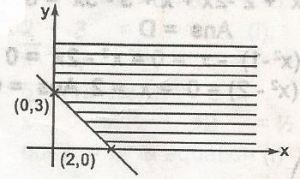
- A. x ≤ 0, y ≤ 0, 2y + 3x ≤ 6
- B. x ≥ 0, y ≥ 3, 3x + 2y ≥ 6
- C. x ≥ 2, y ≥ 0, 3x + 2y ≤ 6
- D. x ≥ 0, y ≥ 0, 3x + 2y ≥ 6
Philemon teaches that the benefit of forgiveness is
- A. endurance
- B. responsibility
- C. restoration
- D. edification
After each of the following sentences, a list of possible interpretations of the sentence is given. Choose the interpretation that you consider most appropriate for each sentence.
The students were advised to face their studies and let sleeping dogs lie. This means that the students should
- A. obey the authorities
- B. organize themselves properly
- C. leave matters as they are now
- D. be as watchful as sleeping dogs
The process of mobilizing, engaging and maintaining workers to work for an organization is referred to as?
- A. staffing
- B. selection
- C. recruitment
- D. employment
The development of an economic hypothesis through intuition, insight, or logic is associated with
- A. Deduction
- B. Policy economics
- C. Normative economics
- D. Induction